
The internet knew the practice. It didn't know him.
A great doctor, filed under “and providers.”
Paul Knoll is a Nashville native, the son of a Nashville urologist, and a physician patients drive across Middle Tennessee to see. He practices at one of the state's largest urology groups — thirty-five physicians, fifteen locations, a name that's been trusted for generations.
That's a wonderful place to practice medicine. It's a hard place to be found.
Search the group and you'll find the group. Search the man and you found directories, hospital systems, and practice pages. The internet knew the practice. It didn't know him.
The questions men don't ask out loud.
Listen to how this actually happens and the whole problem reframes itself. Nobody researches a urologist at 2pm on a Tuesday. They do it at 11pm, alone, typing a question they haven't said to another human being — and what they need first isn't a credential. It's a person who seems safe to ask.
That person already existed. Paul takes his time, answers the questions men are reluctant to ask, and makes sure you leave understanding your condition. None of it was findable.
He was studying the problem too. He sent us sites from physicians around the country who market men's health well and told us what he wanted to learn from them. Show us a client who studies the craft, and we'll show you a story that ends well.
His own name, on his own door.
We built drpaulknoll.com — a place that is deliberately his. Not a rebrand: he carries his practice's colors proudly. But his own ground — his name on the domain, his voice in the words, his framing and positioning, his care and educational posture — front and center. A site whose whole job is to let a nervous patient meet the doctor before they ever call.
Within two months, a website project became a standing partnership — strategy, educational content, and the patient work of building presence month over month. We told him then, in writing, exactly what we tell everyone: this is educational value for patients on day one, and search value over time.
No shortcuts. There was no paid media. There still isn't.
Nobody builds this alone. That's the point.
Here's the part most marketing stories leave out: the website didn't do this. The mix did.
Paul wrote — long-form patient education on ED, enlarged prostate, blood in urine, drafted by the person who actually answers these questions in exam rooms. Somewhere in year one we caught ourselves saying it out loud, "Paul is both doctor and copywriter!"
His partnerships showed up. Boston Scientific's men's health team brought patient education resources, animations, and the HARD series — a documentary series on the real impact of ED — which lives on his site because of who he is in that field.
His patients showed up. Real reviews, engaged and answered, one at a time.
And his practice's presence and his personal presence reinforce each other — the group and the individual working as one thing, which is what a mix is.
Our job was never to be the hero. It was to make all of that legible — to patients, to Google, and lately to some newer readers.
Time did what time does.
Organic traffic: 6x
Top organic result
Appointments: 2.5x
Good things get found
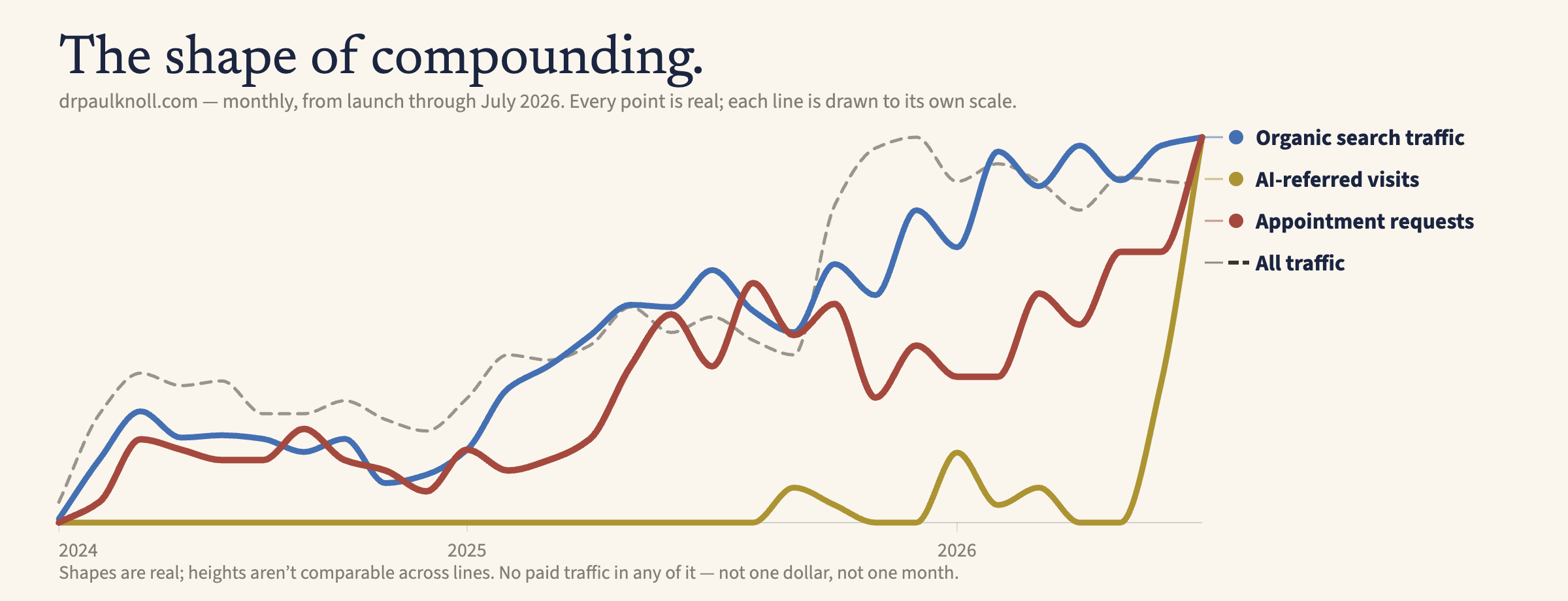

And now the machines are recommending him too.
This year, something new started showing up in the data: patients arriving from ChatGPT. Not a fluke — a steady monthly stream, and it's climbing. Ask an AI assistant to name Nashville's best male urologists and Dr. Knoll appears in the answer, described in words that trace back to the pages we built — because we've spent this year making his site as readable to AI systems as it is to patients: structured credentials, connected profiles, machine-verifiable facts about who he is.
Notice who gets named in those answers: the physicians who exist as people online, not just as entries in a group roster. The decision Paul made at the start — his own name, his own door — turned out to be the exact preparation the AI era rewards.
This story doesn't have an ending yet. Most of ours close with a problem solved; this one compounds — server performance and security, more SEO, AEO & GEO work, new content, review by review, month by month, the same honest method now legible to search engines and answer engines. We've benchmarked where he stands today, query by query, so the next chapter gets measured instead of guessed.
Great doctor. Now the internet knows.
Marketing isn't a channel. It's a chorus.
The doctor who writes, the practice that refers, the partners who contribute, the patients who review, the site that makes it all findable — none of it works alone, and none of it works fast. All of it works together, and it's still working.
The businesses that get named in the new answers are the ones that were worth naming in the old ones. There was never a shortcut to being worth finding. There still isn't.