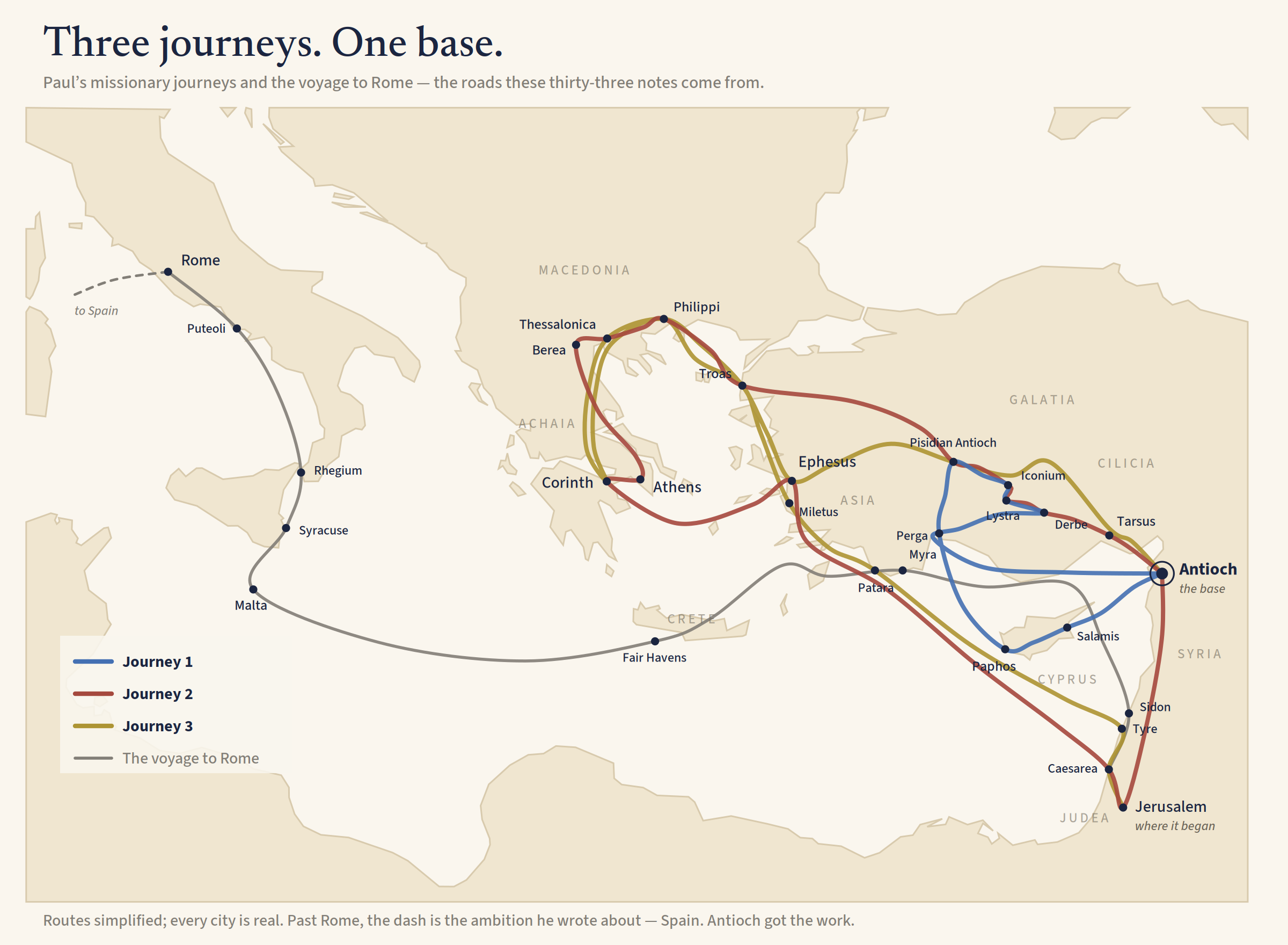
Paul, the Marketer.
The greatest marketer of all time is Paul. Yes — the apostle. First century. No budget, no media, no institution behind him — and two thousand years later, the result every marketer claims to want: advocates who carry the message themselves.
This page is the series’ home. Thirty-three notes, organized into seven parts — the whole map, and the story of where it comes from.
Where this comes from.
I came to marketing from the mission field. The lessons from my faith kept showing up in my marketing. For more than twenty years, reading Paul’s journeys has filled my notebooks with marketing musings — the roads, the rooms, the letters, the people. My bookshelves hold great marketers like Seth Godin and Philip Kotler. Biographies of wildly innovative business enigmas like Steve Jobs and Elon Musk. Business staples like Jim Collins' Good to Great. All next to Lloyd-Jones' exposition tome on Romans, Robert Banks' Paul's Idea of Community, N.T. Wright's Paul: A Biography, Journeys of the Apostle Paul by Craig Keener and David Bomar (and several others) ... Bible studies, commentaries, and more.
The idea — that what we can learn from Paul and the Bible can be applied very specifically and effectively in marketing — did quiet work long before I made this teaching public. The connected-community strategies I’ve built in every organization I’ve served came straight from koinonia — a word you'll soon learn more about.
For many years, I've tried to turn this idea and these notes into a book. I usually stop after a few pages or a few chapters. The first sentence is always the same, "The greatest marketer of all time is Paul. Yes, Paul — the apostle." The book stalls for a lot of reasons you can imagine. The idea doesn't.
So, for those of you still reading: these posts are for you. We're publishing the way Paul published — letters, translated into a modern vernacular and medium: posts.

How to read it.
The seven parts.
The greatest marketer of all time is Paul.
Paul always went to the synagogue first.
Paul never worked a dead end.
Paul made tents.
Paul picked his people.
Paul never built a crowd.
Paul means small.
The thirty-three notes.
Sent, not selling.
Inspired, not convinced.
Trained, not just inspired.
Worldview drives everything.
A connected-community, not a list.
Your own community first.
Permission, not interruption.
Their altar, their poets.
Watch who says yes.
Antioch, not Jerusalem.
Synagogue, agora, home.
The next city on the road.
Everyone, one honest test at a time.
One message, many letters.
Thinkers, doers, and thinking doers.
Eutychus has a name.
Carry yourself well.
Credibility on your own terms.
Cūra.
Small work compounds.
Somebody went to Tarsus.
Chosen on witness.
Trusted with the rooms.
Trusted with the letters and the follow-up.
Disagreement.
Building with people who aren't.
Crowds turn. People stay.
Values, not demographics.
Generosity, hospitality, the table.
Take away the good press.
Take away the plan.
Take away the home field.
Take away Paul.
The seed.
Paulus means small.
The apostle who spread the Gospel in a big way had a name meaning small. Jesus taught what can happen when small things are planted well: a seed, the smallest of seeds, can grow into a giant tree the birds nest in.